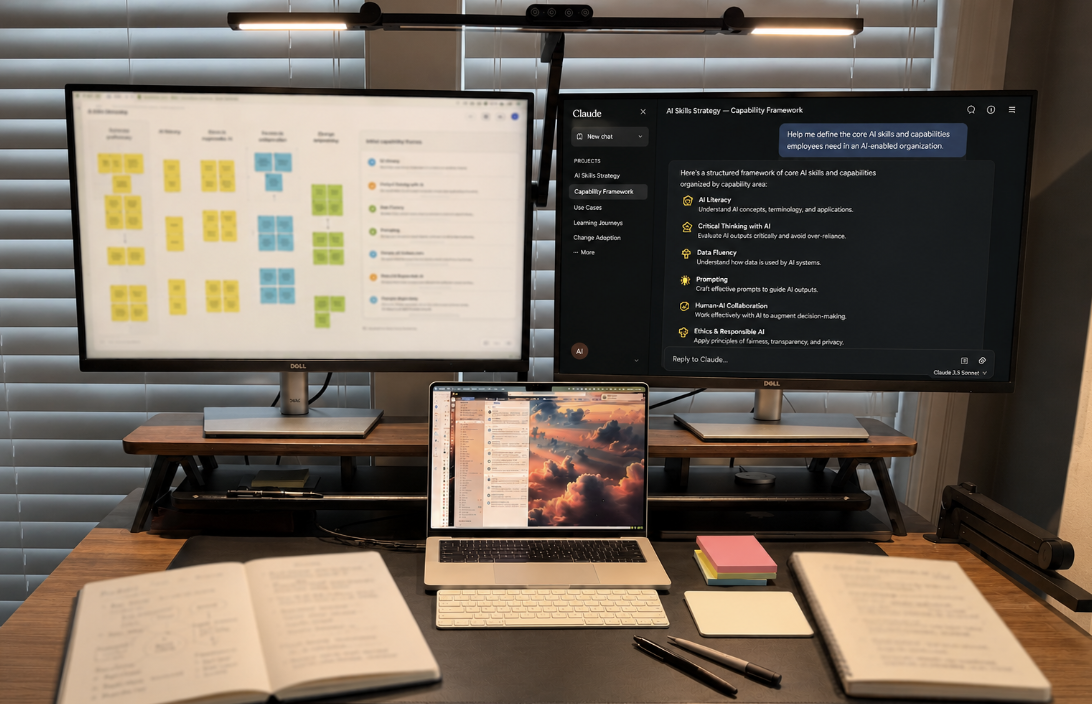
Case Study: AI Skills for Design Discovery · ServiceNow Workflow Design Studio · 2025–2026
A high-performing team was struggling to scale. Their work was excellent, and leadership wanted more.
1. CONTEXT
In the past few years, ServiceNow has been experiencing increased competition for enterprise IT budgets. On one front are traditional players such as Salesforce, Microsoft, and BMC Helix. On another, there is growing pressure from OpenAI, Anthropic, Palantir, Google, and many more. In this environment, customer expectations have shifted, as has their purchasing behavior. They're moving away from long implementation horizons and drawn-out contracts towards shorter agreements anchored on visible proof that the vendor can provide value in the customer environment.
2. SITUATION
ServiceNow's Workflow Design Studio had a 10-year track record of delivering results for ServiceNow customers and account teams. Engagements already delivered what customers wanted: a tangible demo and reference architecture on which it would run. However, those engagements typically ran 10–12 weeks, often longer. Due to shifting customer expectations, there was executive pressure to compress timelines so the team could handle more volume without cutting scope or adding headcount. The team had tried various approaches and tactics over the years, but none proved to be reusable or scalable.
3. APPROACH
Start with observation. I shadowed two strategic engagements to assess how the team was spending its time and where there might be opportunities for efficiencies. It was an "active shadow" role, so I was doing as well as observing. I asked questions about why things happened the way they did and probed where I saw potential. Over time it became clear what was essential, what wasn't, and which activities required a human, which could be autonomous, and which could be automated with human oversight.
In those two projects, a clear choke point was any time the team was synthesizing data. It was vital that we preserved all the voices, not just the loudest or catchiest. We had to reflect sentiment, severity, and frequency of themes. The more data there was, the longer it took. This was a prime opportunity to enlist AI. I posed this theory to other team members to see if it was true across a larger sample. It was.
Leverage AI where it made sense. I prototyped a tool chain composed of 8 AI skills, 6 of which were focused on collecting, normalizing, and reusing data gathered throughout an engagement. As a system, the skills ensured verbatim capture, accurate classification, and pinpoint attribution. The system reduced our synthesis time by over 80% and gave us the ability to verify and cross-check its suggestions. I tested the system on my next live client engagement and it passed with flying colors!
Spread the capability. I packaged up the tool set and led a team training. My peers were eager to apply the efficiencies for themselves; 5 of 6 of them applied at least 1 skill within the following month.
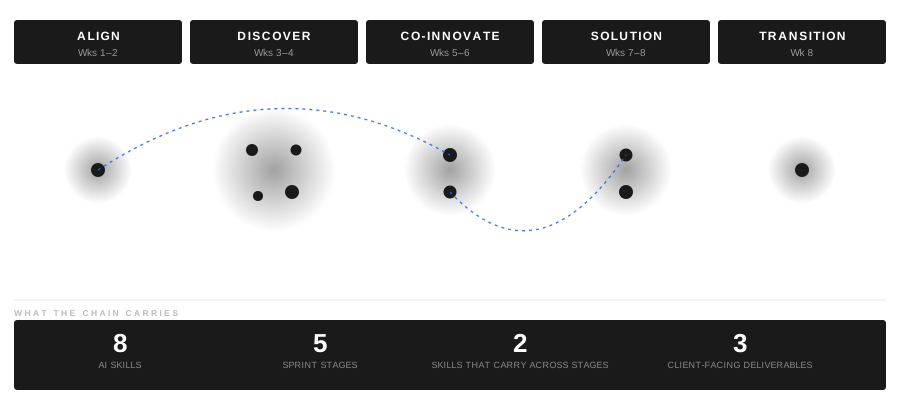
AI skills apply across the entire engagement
4. OUTCOMES
The AI-powered tool chain I created replaced manual synthesis and tracking with an encoded methodology, freeing strategists to focus on strategic decisions and client management.
What Changed
8
AI skills designed and built from scratch, encoding methodology proven to streamline work, surface themes, and improve traceability and accountability.
5/6
Peer strategists adopted at least one skill within 1 month of release.
80%
Reduction in manual synthesis time, which freed capacity for strategy and client work.
See how these team efficiencies improved outcomes in the Design Sprints case study.